Welcome to a more or less Celtic Reconstructionist blog, where love of the Old Gods is still strong
Posts mit dem Label Pagan Blog Project 2012 werden angezeigt. Alle Posts anzeigen

Samstag, 2. Juni 2012

KISS Mythology – A Very Eclectic Way of Calling the Quarters

Better late than never... I’ve been meaning to post for some time now, but life kept getting in the way in the form of work, a concert of the fabulous Bruce Springsteen which I’d been waiting to see for more than 10 years now, theatre planning sessions (we’re performing As You Like It) and other stuff.
So, finally, for my first K post in the wonderful Pagan Blog Project challenge, I’d like to leave my usual route of discussing Celtic or Northern gods and mythology and delve into something far more eclectic: KISS mythology.

Yes, you guessed correctly: by KISS I mean the 80s hard rock band. My dad was a big fan of their songs, and when I was 10, he introduced me to their music. I still remember the Saturday afternoon when we sat in my great-grandma’s room, listening to KISS’ Dynasty record. So in the sense that KISS will always be connected with this moment and the memory of my dad, they are a very important, almost magical band to me. 
 The original band members: 
Gene Simmons as Demon, Paul Stanley as Starchild, Ace Frehley as Space Ace and Peter Criss as Catman

In the late 1990s, when out shopping for magazines, I found the first Psycho Circus comic by KISS in our local railway station shop. Naturally, I had to buy it although it was fairly expensive at the time. I read it right when I came home, and I was mesmerized. The Psycho Circus series describes the life of circus artists, who are inseparably linked to the Four-Who-Are-One, i.e. the mythologized versions of the KISS stage personas.
The second instalment of the series described these characters as follows:

The Demon - Lord of the Wasteland - Creature of fire and shadow, blood and thunder. He embodies vengeance and terror, the darkest impulses of mortal souls, but also the purgative flames of rebirth, destruction that proceeds creation. His is the element of fire.

The Starbearer - Prince of Hearts - He who draws from the deep wells of the soul and emotion, bringer of passion and pain. He can move a heart to tender love or murderous rage. His is the element of water.

King of Beasts - Lord of the Hunt - Personifies the primal animal instinct, the rough beast that stirs in each of us. Embracing instinct rather than intellect, he knows neither cruelty nor mercy. His is the element of earth.

The Celestial - Scion of the Cosmos - Represents the principles of universal balance, the ultimate harmony of the cosmos. Observes situations dispassionately and sees all sides of a dilemma. His is the element of air.

At about the time I read these comics, I started with my first tentative steps on the road to paganism. Unfortunately, all that was available in my small town’s library were not-so-well-written books on ghosts, spirits, DIY books on white magic etc., none of them by well-known authors. So what my best friend at the time and me did was more or less develop our own, very much eclectic ideas of what witchcraft was and how we could work with it.
Quite a lot of the books I read talked about calling the corners or elements, but none gave an appropriate description of how to do it that appealed to me. For me, these elements were too abstract to do anything with them, much less call on them and interact with them. But then I realized that in the KISS comics, the Four-Who-Are-One each represent one element. Hence, I devised my very eclectic version of calling the quarters that I still use today when working magic.

My plan, which I still have to follow up on once I’ll have a bigger flat and a room devoted to my craft, is to decorate each room’s corner with symbols and items that I associate with the elements as described in the Psycho Circus comics. I also have certain smells and natural phenomena that I associate with them.

Here are my associations, in no particular order:

Fire: red, the midday sun, the desert, burnt smells, death, danger, rebirth, fights

Water: deep red or violet roses, purple, deep ponds, the sea, rose gardens, romance, heavy rose smells, emotions, the sunset, the pains of love

Earth: green, lush green flowers, the smell of the earth after the rain, the woods, animals, stones, sticks, natural materials, earthy green or brown smells, night, wilderness

Air: white and black feathers, blue, planets, coldness, the wind, wind chimes, clear high notes, clean smells (such as Davidoff’s Cool Water perfume), fresh blue smells, the void

This is also my main reason why I see Water as purple and Air not as yellow, as in many traditions, but as blue.

I use these correspondences for various reasons. First, I use them to call the quarters when I’m working magic. Since I’m so familiar with both the comics and the band, I have an instant, very personal image for each element when I call upon it; this seems to work better for me than to use somebody else’s version of the elements.
Second, I use the colour correspondences and/or smells to invite a certain mood or emotion into my day. For example, if I think that I’ll need to be very susceptible for emotions, e.g. when speaking to a friend who’s lovesick, I’ll wear something purple or use my rose perfume. On the other hand, when I know I’ll be in a situation where arguments will likely arise, I’ll rely on a red pendant and focus on the Demon aspect, i.e. that from each conflict and each death, something new will arise. And finally, I also use them as focalizers, so to speak, for visualizing which abilities I’d like to invite into my life. 
 Madame Raven using her tarot cards and calling upon the Four-Who-Are-One*

While this is indeed a very eclectic system that isn’t even based in a ‘proper’ mythology, it has been proven to work time and again for me. I’ve also written a story based on Madame Raven, a member of the circus, and her ability to call on the Four-Who-Are-One using her tarot cards (you can order the book that includes my story here).

So how do you call upon the elements? Which are very eclectic practices of yours, and what are they based on?

Blessed be,
Harzgeist

Sources:
KISS Psycho Circus volumes 2, 6, 10
KISS band image: http://www.nolifetilmetal.com/images/kiss_circuspic.jpg

* a translation of the German reads: 
I call out to the North in the name of Starbearer, prince of hearts, who draws from the springs of soul and emotion. 
I call out to the West in the name of Beast King, master of the hunt, protector of nature. 
I call out to the East in the name of Celestial, spawn of the cosmos, wo represents universal balance. 
I call out to the South in the name of Demon, lord of the wasteland, sinister executor of vengeance and terror.
I hear Madame Raven calling upon the four directions. Her voice is so soft... I am very close to her, but far away...

Sonntag, 6. Mai 2012

Inspiration and Identity


A lot of Pagans I’ve encountered like to give offerings to our Gods – some offer physical objects, like wine and mead, some offer crafts they’ve created, like altar cloths, and some offer their talent, like singers. Being a writer, I do the latter. 

When you’re working in a creative field yourself, maybe you’ve also felt this sudden pull to take that notebook or sketch pad and paint or write down this unexpected new idea. Perhaps you – just like me – have wondered where these ideas, this art of ours comes from. 
Clearly, some of it is inspired by other works of art I encounter. When I was still at school, I read a lot – about one to two novels a week. Today, I don’t have as much free time, but I still try to read as much as I can, at least the new works of my favourite writers. And I attend a Creative Writing course once a week, where I can present my writing, get feedback and also get new ideas. But one question still remains: Where does this divine spark to create something new come from? 

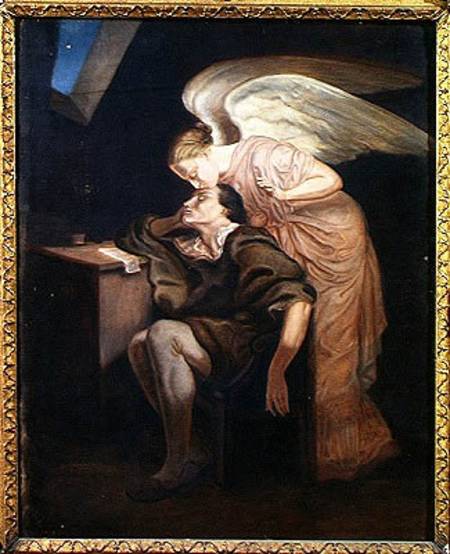
I like to think about this in terms of my muse (cf. King 2000): He lives in an old, run-down changing room in a theatre (don’t ask me why he likes to hang out there; but I’ve never seen him anywhere else). He looks a little like Jim Morrison, with wavy brown curls, and always wears a white v-necked shirt and faded blue jeans. When he helps me out with a story, I pay him in whiskey or similar hard alcohol. But I have to keep up my part of the bargain – when he sends me that inspiration, I have to write it down and acknowledge it, even if it means getting up at 3am and searching for a pen and notebook. 
 You could say that when I’m talking to my muse, what I’m essentially doing is talking to my own subconscious which, for some unfathomable reason, likes to dress up as Jim Morrison’s look-alike. But be that as it may, I wonder how our Gods feature in this process. After all, Odin grants the mead of poetic inspiration; in the Celtic pantheon, Brighid is associated with the “fire in the head” of inspiration (also see my B post on Her). However, when I’m writing I’ve seriously never felt Their presence, even if the work I produce is about Them.
So while I see writing as an integral part of myself (hence the Identity title), I still don’t know what makes me, or rather, what drives me to write. What I know, however,  is how to write and how to be inspired. 

So how can we make inspiration flow (cf. Myers 2008: 477)?
  • First of all, learn as much as you can about your craft – only when you have a good working knowledge of what has been done, of different styles etc. can you combine them in new, interesting ways.
  •  Be risky – sometimes, you have to take a certain risk: you won’t know if combining a horror story and crime elements will work unless you try.
  •  Learn to see things in new, creative ways – e.g. what could you use a brick for? To build houses, sure, but couldn’t you also use it as a paper weight, as a weapon, as a doorstopper, as a device to keep your table from wobbling? It’s these instances that will give you new insights and inspire you to come up with novel stories. 
  •  Look for others who are creative and who will support you – your creativity can thrive best if there are others who are either creative themselves, so you can inspire each other, or when they are accepting of your craft. Imagine writing a story when your SO keeps telling you that it’s a waste of time and/or silly – you’d have to be very dedicated to keep at it! Also, create an “imaginary friend,” your Constant Reader (or Constant Gallery Visitor, or Constant Concertgoer). S/he is your prototypical target audience. So you can ask yourself while working on your creative product: would Constant Reader enjoy this? Does s/he expect something entirely different now and will s/he be disappointed if s/he reads, sees or hears my new take on things? Basically, Constant Reader allows you to keep your intended audience in mind and not to stray too far from your intended path (King 2000).
  • When you’re planning to work creatively, no matter if you’re planning on being a professional artist or if you’re just working for yourself, you have to want to do it, simply because you enjoy the process of doing it. It has been shown that when two groups of people work on a creative project, the ones who are told that their work will be judged are less creative. So just write for the sake of writing, sing because you love it, and you’ll come up with more new, interesting ideas than if you plan to be the new J.K. Rowling, Montserrat Caballé or Dalí.  
  •  And finally, when you do all the things above, you have to practice continuously. Sure, writing only when you feel that divine spark of inspiration will produce some very nice stories or poems. I, for once, see myself as a Romantic poet who can only write when inspired or called to do so. However, you get better with practice, esp. when it comes to writing stories, dialogue that sounds natural, creating suspense and atmosphere – a writer I’ve met suggested to write a few pages each morning and to keep writing even if everything you turn out feels like s**t, cause this will stop your Inner Editor from complaining and making you feel insecure.
To finish off this post, here’s a poem about Odin I wrote recently. It is inspired both by the German Symbolist poet Stefan George (if you can read German, his poem is here) as well as German Expressionist writers, esp. August Stramm

autumn

the trees were shedding
            their golden gowns
when I found you
            amid the cool forest

unannounced I came
but receive me,
my king,
in your court
            in the twilight woodland

others handed you roses -
but my flowers are wild
and free, like the sun
            that is dying

this final blossom
autumn-blue
take, bind it,
            braid it in my hair -
with your nine sacred herbs
a crown
to make my wedding holy

skies darken, blacken in the wind
autumn air dances
in your war-encrusted curls -
please, leof min,
stay with me
for it is towards evening

silently
beneath the dusk I hear
your laugh,
the night,
the cruel blue winter wind -
and the Wild Hunt
is coming

 
Sources:

King, Stephen. 2000. On Writing. A Memoir of the Craft. London: Hodder & Stoughton.

Myers, David G. 2008. Psychologie. Heidelberg: Springer [German edition]. 

http://www.alb-neckar-schwarzwald.de/s_george_poems.html (Stefan George’s “komm in den totgesagten park“ in both German and English translation)

http://www.firstworldwar.com/poetsandprose/stramm.htm (English translations of two of August Stramm’s poems)

images:


http://www.paranormal.de/symbole/germanen/Odin/Odin4.jpg (Odin)


Dienstag, 17. April 2012

Holidays - Learning from Non-Pagan Celebrations


When I was staying at my family’s for the Easter holidays, I realized two things – one I talked about in my last post on gospel songs and paganism. The other is that we can learn a lot about each other by attending spiritual services of other faiths, and also enrich our own pagan practice.

My family has always been Christian, although not overtly so – my great-grandma would pray the rosary every week, but privately, and my gran also prays by herself each night. Since my dad passed on three years ago, however, my mum quite often attends services with my little brother (8) and me. As I don’t live at home anymore this usually this happens three to four times a year around the holidays, i.e. Christmas, Easter, Thanksgiving and potentially the service held in summer at a local site in the mountains.

So today I’d like to talk about the last Easter service I went to and what I learned from it.
First of all, I find that attending a Christian mass once every so often is a good and easy way to remind me of the core tenets of Christianity. Not that I’d forget that Easter commemorates the occasion of Jesus rising from the dead, obviously. Instead, the sermon reminds me not only of what is celebrated, but also of what it means for believing Christians. For Easter, this would be a sense of hope pervading all aspects of their life, and a belief that they, too, will rise one day to be with their God. Hearing sermons like these and understanding what it is that Easter means for Christians helps me to see parallels to my own pagan faith. 

the altar of the church my mum attends

This brings me to my second point, i.e. that once I see that the sense of hope Christians feel at Easter is similar to the hope and joy I experience during the spring equinox ritual, I might be able to better explain to friends and relatives what it is that I celebrate and believe in. So when I can show that while I do not believe in Jesus, I do focus on hope and the good things in life (that is, not on courting the devil and eating little children), we might have some common ground – and if we cannot agree, maybe we can at least peacefully co-exist, knowing that the other’s beliefs are not too far from one’s own in a sense.

The third and main aspect that really struck me during this year’s Easter service is that in my own pagan practice, I really do miss the sense of community. On the one hand I’m quite happy to be a solitary practitioner, since my schedule is quite messy at the moment and I don’t think I could find time for a regular meet-up; and I also want to explore more of paganism in general before settling for a certain group’s way of doing things.

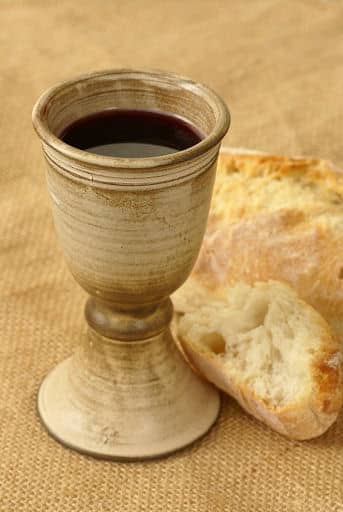
But on the other hand, I really do miss feeling a community spirit. In my mum’s church, the congregation gathers in a circle in front of the altar for the holy communion, and you can partake of both the wine and bread (my dad’s Catholic church, where I used to go to when I was young, only had the priest consume the wine, so this is a really interesting experience for me). After everyone has partaken of the bread and wine, you take your neighbour by the hand and the circle is blessed by the priest or priestess. This sharing of bread and wine, to me, is closer to Jesus’ original idea than the Catholic practice that I grew up with, and it also reminds me of the fact that you’re not alone, but celebrating your faith together with others. 

 
Also, I simply love singing with others to praise God. While I’m quite happy with my own singing voice, it just doesn’t compare to a whole church packed with people singing well-known gospels.
And finally, I miss having a proper ritual structure. I do like to experiment with how I do ritual. However, I find that once you have a set structure you can concentrate better on what the words and gestures mean to you personally instead of fretting about getting the next ritual step right. Also, a fixed structure gives me a sort of comfort, because no matter where you enter a church of a certain denomination, the structure will be the same (or very similar, at least) and you can feel instantly at home.

So how can I adapt the things I miss into my practice?
I talked about the gospel songs last week, so I’m not going to go into detail here. As to the community aspect, I’m planning on asking a Wiccan friend of mine if we could celebrate some of the sabbats together. While I’m not Wiccan myself, I guess our core beliefs are close enough for us to get a meaningful ritual structure that we could work with. Another friend has asked me whether I’d do a little pagan ceremony on our annual Walpurgisnacht trip up the local hill (Walpurgisnacht is the night between April 30th and May 1st, i.e. the German version of Bealtaine), so if all present are fine with it, I might share some bread and mead with the group.
And as to the ritual structure, I don’t have a perfect solution just yet, but since the structure I used for my spring equinox ritual worked really well, I might use it again for the next sabbats and see if I want to stick to it.

As a conclusion, joining my Christian relatives in church is a good way for me to see what they believe in and celebrate on their holy days, and it also gets me to reflect about the current state of my own faith and how I can make my celebrations be even more to my liking.

Do you have other thoughts about attending mass (or the services of other faiths, depending on what faith your relatives adhere to) together with your family? Do you do it at all, and if not, why? 

Blessed be,
Harzgeist

Montag, 16. April 2012

Gospel Songs in Paganism?


Today, I’d like to share with you an experience, or rather a realization, that I had while I was attending the Easter service together with my mum this year. The church she attends has quite a lot of songs that I enjoy, and I found I really loved singing along with the congregation.
I’ve also been a member of a gospel choir during my time in England, where I went twice a week – sometimes more often, when a concert was approaching – to sing songs praising God. But it only occurred to me during this Easter service that there hardly are any gospel songs that we can sing as pagans.

Obviously, there are quite a lot of songs with a pagan theme, often written and sung by pagan artists. For example, I do love the work of Damh the Bard; his rendition of the Raggle Taggle Gypsy never fails to make me smile, and his The Spirit of Albion gives me goosebumps quite often.

However, apart from a song by Kellianna called I Walk with the Goddess there is hardly a truly pagan song I know that comes close to gospels like, say, Elvis Presley’s rendition of Working on the Building that I could use during ritual. 

The fact is that I love music, so naturally I would like to use music to celebrate my gods. While chants can be very powerful when used in ritual, I’m looking for gospel-like songs that were written for the praise of our gods and that you can sing along to. For me, there’s a certain challenge in getting the key and difficult bits in a gospel right, so I’d like to be able to give a well-sung song as an offering, so to speak.

However, I don’t feel that using existing Christian gospels and changing the lyrics is appropriate, in a way. I do appreciate the efforts by e.g. the German Asatru-Ring Frankfurt, who have quite an extensive library oflyrics – either Christian-themed songs changed to fit pagan rituals, like their Yule songs, or modern pop songs changed to incorporate pagan and Heathen ideas. For example, there is quite a nice Heathen version of Dolly Parton’s Jolene titled Wotan (Heart of You), directed at Odin. My problem is, however, that you’d have to find an instrumental version of these songs to use them during ritual (as much as I like Mrs Parton, I don’t want her to sing about Jolene when I try to devote a song to Odin – and if I don’t have musical accompaniment, I go terribly off key, and no God wants to hear that, believe me).

I also tried to change the lyrics of a song I learned in the gospel choir (it’s called He Reigns; a version of my choir performing it can be found here).
While I managed to get as far as
“Our God is an awesome God, 
He reigns from Asgard above”
the next line that says “with wisdom, power and love” wouldn’t quite fit my view of Odin (wisdom, yes – love, not so much); and besides, “Asgard” wouldn’t quite go into the metre anyway.

So essentially, what I really miss at the moment are gospel-like songs that are pagan-themed – or at least neutral enough for me to use them during ritual. Are you familiar with any songs that I might enjoy?

Blessed be,
Harzgeist

Donnerstag, 29. März 2012

Giamos and Samos – Celtic Worldview I


For my first “G” post in the Pagan Blog Project, I’d like to address one of the fundamental distinctions in the Celtic world, namely that of giamos and samos.
In the Celtic mindset, we can see a primary guiding concept of universal duality; in the words of Alexei Kondratiev, one of my favourite scholars in the field, this duality can be expressed as “Day and Night, Summer and Winter, God and Goddess, Tribe and Land,, this world and Otherworld” (Kondratiev 2003: 79).

It is the differences between these principles that allow changes to occur (Kondratiev 2003: 80). In this case, the Celtic worldview seems to be similar to the concepts of Fire and Ice in the Northern mythology, since the contact of both these elements created Ymir, the first living being (Prose Edda, 4). 
Kondratiev (2003: 88) agrees when he notes that “fire and water are of primary ritual importance in Celtic tradition, representing the polarity of samos and giamos.” So maybe the similarities between these concepts will help me incorporate more Northern elements in my practice to honour the Northern gods I follow.

But now to the topic of my post: 
The Celtic year is separated in two halves: giamos and samos; Freeman (2001: 5) refers to this as gam and sam, but her distinction is essentially the same. The terms were developed by Neven Henaff, a Breton nationalist thinker of early 20th century (Kondratiev 2003: 79).
The giamos period encompasses the time from November 1st to May 1st and is thus the Night or Winter half of the year. The period represents the Goddess, the land, the dead, as well as all unconscious activity (Kondratiev 2003: 81). According to this definition, rituals should begin after sunset – apart from those that are specifically designed or required to be held during daylight, such as Bealtaine (Kondratiev 2003: 87).
The samos period, on the contrary, is understood as the Day or Summer  half and goes from May 1st to November 1st; it represents the God, the tribe, the living, and all conscious activity (Kondratiev 2003: 80).
 For Celtic peoples, the year started with the giamos period at Samhain, since “unconsciousness precedes consciousness, an unseen gestation of the womb precedes birth, and so Winter is felt to be the gestation of the Summer” (Kondratiev 2003: 97); likewise, days start at sunset. We can thus see that all time structure can be divided according to the samos/giamos principle. The concept also pertains to space, where South is equalled with Night and North with Day (Kondratiev 2003: 80). However, we’ll go into more detail once we reach “Q” for quarters.

Looking at the four seasons that we know and celebrate today, we can say that Spring is the samos- or summer-oriented half of the giamos (winter) season – Spring still belongs to the Winter half of the year, but we feel that the sun is getting warmer and flowers start to bloom. On the other hand, Harvest is the giamos (winter)-oriented half of the samos (summer) season), because the days are getting shorter and it is already getting colder, although the Harvest belongs to the Summer half.
This gives  us the following calendar of festivals:
o       Samhain at the beginning of Winter
o       Imbolc at the beginning of Spring
o       Bealtaine at the beginning of Summer
o       Lúghnasadh at the beginning of Harvest

During the time from Samhain to Bealtaine, we witness changes within the land – snow falls, then covers the earth during the Winter Solstice, and thaws again to allow new flowers and new life to grow.
In the time from Imbolc to Lúghnasadh, however, we witness changes pertaining to the tribe, i.e. humans, and the land, since it includes the time of sowing, growing of crops, and the harvest (Kondratiev 2003: 109).

The concept of samos and giamos can also be found in the ritual rivalry between the two consorts of the Goddess – the Maponos figure and Cernunnos. 
In Celtic belief, Cernunnos is not seen as a horned god, but as a god with antlers – this is a necessary and important distinction, since antlers fall off and grow back, and so represent natural changes (Kondratiev 2003: 105f.). During the summer half of the year, Cernunnos has lost his antlers (and thereby his consort and his creativity); he now is in his personal giamos-(winter) mode of contemplation. When the world turns to winter, Cernunnos is re-united with his consort the Goddess and his hence capable of active exchange which will renew the land (hence he enters his own summer/samos mode) (Kondratiev 2003: 108).

Looking at his rival, the Maponos, we can describe him as the “archetypal young lover” (Kondratiev 2003: 108), expressing vitality and youth. He is born by the Goddess at the Winter Solstice, then grows up to mate with Her on Bealtaine, and goes into the giamos (winter) mode together with the land, i.e. he is imprisoned or dies as the year progresses, to be freed or reborn at the Winter Solstice (Kondratiev 2003: 109).
Wiccans might be familiar with this system in the form of the Holly King (similar to Cernunnos’s role) and the Oak King (the Maponos figure ruling through the summer period). This distinction is beautifully expressed in Damh the Bard’s song Noon of the Solstice, which can be found here.

My final question is whether we can work with this mindset outside of rituals and magical workings, since people do get confused when I wish my Wiccan friend a happy new year halfway through our annual Halloween party.
What do you think?

Blessed be,
Harzgeist

Sources:

Freeman, Mara. 2001. Kindling the Celtic Spirit. New York: HarperCollins.
Kondratiev, Alexei. 2003. The Apple Branch. A Path to Celtic Ritual. New York: Kensington.

Sturluson, Snorri. The Prose Edda. Accessed online (and in German) here.

Damh the Bard – Noon of the Solstice: http://www.youtube.com/watch?v=mFvpMObnzB8

Sonntag, 25. März 2012

Finding your Deity


For my second F post in the PaganBlog Project, I’d like to address the question of how we pagans find the deities that we pray to and worship.
It seems that there are several ways in which worshippers find their matron or patron gods.
But before we start on those, remember that you don’t have to have a certain deity you follow to be a pagan – some practitioners took years to find theirs, and others are quite happy working magic or walking a pagan path without belonging to a specific goddess or god. So don’t stress if you haven’t yet connected to a certain deity.
So, now on to finding your deity:

One way of finding your deity is by research, so to speak. Some have always been attracted to a specific culture or pantheon, and reading the myths they find a goddess or god that speaks to them. If that is the case with you, you can start to worship Them by leaving offerings, and (hopefully) slowly form a deep, fulfilling connection to this deity.
So, for example, somebody who works in a healing profession might easily connect to Brighid, as well as a poet might seek Her inspiration or “fire in the head.” I also felt drawn to Persephone from childhood on, as I loved my book of good-night-stories that also included Her myth. Eventually, I found out that another goddess was responsible for me, so to speak, which brings us to our next point.
an image of Persephone, Demeter and Hades from my favourite children's book
There are some within the pagan community who are simply found or claimed by a deity. Sometimes accepting this claim is not easy, since you might not have expected this specific deity to have an interest in you. Usually you’ll know when a deity claims you – connections with this deity seem to pop up everywhere you look, you’ll be visited in a meditation, or you’ll feel what some describe as a distinct “spiritual slap on the head” by the deity, telling them that they are Theirs. Essentially, this is how I met my matron, Anann (Who I used to mistake for Persephone, since She is also connected to the earth and to death). Why She chose me I cannot fathom, but I’m sure I’ll find out one day what work She wants to be done.

Sometimes it can happen that despite everything I’ve just said, you fail to notice that a certain god or goddess is trying to get your attention (although once you realize it it’s usually glaringly obvious). As a general example, a pagan might get followed by ravens all of a sudden (especially in places or times of the year when there shouldn’t be as many ravens about), at the exact time that they feel compelled to start practicing martial arts, and only after a very long while realize that the Morrighán is calling them. But if you’re involved with a pagan community, telling your fellow pagans about coincidences like these will usually get you pointed in the right direction quite easily.
I should mention here that sometimes, people will be called by a god or goddess Whose lore hasn’t survived, but since I don’t have any experience with this myself, I won’t stress this part here (if you are familiar with this, however, I’d love to hear about your experience!).

And then, there are situations when you might perfect well realize Who it is that’s calling, but are unwilling or afraid to form a connection. In my opinion, this is the most difficult outcome. Not seeing a connection, obviously, can happen sometimes, but I’d be cautious if I’d wilfully ignore a deity.
However, I guess that it depends why you’re ignoring Them. Did you hope for a different deity of the pantheon to contact you and be your matron/patron? Or, let me put this provocatively, is this specific deity not “fancy” enough (as in, everybody worships Brighid, so why do I get called by Donn)? Or do you shy away from forming a deeper connection because of, how shall I say, reverence?
For me, reverence for Odin was what kept me from approaching Him for the last 10 or so years (boy, do I feel old right now!) – that, and not knowing how to approach gods, since the internet and books on paganism hadn’t really made it to my little hometown in the late 90s.


 It was only lately that I realized how many connections to Him are basically staring me in the face.
First of all, I am an academic, currently working on my PhD, so it would only be fitting to start a relationship to the god of wisdom and knowledge. Then, Odin is also a god of poetry Who gives the mead of inspiration and creative fire – I see myself as a writer, and my greatest dream is to be a full-time writer of horror and crime fiction.

But there are also other, perhaps less obvious connections. For example, the number 9 has always been my favourite number. Using a number oracle that I believe originated in the Kabbalah tradition (I’m not really sure anymore where it came from; I noted it down in my book of shadow-of-sorts about 12 years ago) my name number as well as my birth number are 9 (and if you combine those, you’ll get your fate number, which is – you guessed it – 9).

Then, I love the colour blue. My room as a teenager was completely blue; the carpet was a deep blue, the walls were light blue, the curtains were blue, and my bed was usually covered in deep blue sheets. Unfortunately, there aren’t any pictures of the room without 15-year-old me (with a weird 80s Jon Bon Jovi hairstyle) in it, so you’ll have to use your imagination ;-)
And I also love the colour black – basically, most items in my wardrobe are black (apart from jeans and the occasional green, blue or red items; and no, I never was a goth) – both colours are associated with Odin.

In my teenage years, I also developed an interest in the military. I read all the books my grandpa had on the military and important wars (and I tried to write an abysmally bad story set in the Vietnam war, which thankfully I abandoned), and I still enjoy war movies like Full Metal Jacket. Considering that Odin is a god of battle, this is quite a fitting interest.
And then, I had one of those new age cassettes (yes, an actual cassette!) with wolves howling in a storm. And I love the time between Christmas and New Year when the Wild Hunt is said to pass over the Harz mountains.

So I’m wondering if it is fate that led me to Him in the end? I’m still trying to figure out what He could possibly want from me, but I believe that time will tell.

So how did you meet the deities you honour? Or does your practice centre on other elements apart from deity worship?

Blessed be,
Harzgeist

Sources:
Persephone image taken from:
Yeatman, Linda. 1985. Bedtime Stories. [German translation, titled “Die schönsten Geschichten zur guten Nacht” by Eleonore Melichar]. Wien: Ueberreuter. p.51.
Odin image: http://silverbough.webs.com/Images/odin2.jpg

Freitag, 23. März 2012

Fundamentalism


“When you were young
And your heart was an open book
You used to say, "Live and let live"
(You know you did, you know you did, you know you did)
But if this ever-changing world in which we live in
Makes you give in and cry
Say live and let die“ – Paul McCartney: Live and Let Die

A couple weeks ago, my husband found a cartoon on the internet that discussed being pagan from a fundamentalist Christian perspective (the cartoon can be found here, but make sure to shield yourself before looking at it).

It wasn’t even so much the fact that the account was wrong in more than one instance – first of all, initiations work differently, as far as I’m aware, and I assume that not all members of the PBP regularly indulge in role-playing sessions. Getting some facts wrong can and does happen when you’re not overly familiar with another faith (but if you should use your bits and pieces of knowledge for a cartoon is a different question). My problem here is that you can tell that the writers apparently did not take any time to truly understand what it was they were condemning. 

This brings me to my topic of today: fundamentalist attitudes. People as the writers of the above cartoon believe that their path is the one and only true path leading to salvation. So if you believe that yours is the only way, obviously you want to propagate the good news and save others – so from your point of view, you’re acting out of love for your fellow humans. 

However, what some fail to see is that by proselytising their faith, they are effectively discriminating against adherents of other religions – especially if they don’t try and get to know others’ practices or reasons for choosing their religion.  

This shouldn’t be read as a rant against Christianity, however (or, for that matter, against any other religion of which I am not a member). I know many very open-minded Christians, one of them a priest, who’d be willing to discuss your differing positions with you and who’d be prepared to learn more about your faith or lack thereof.

And anyway, it’s not only strongly religious people who can be fanatic, since non-faith-adherents advertise their position quite aggressively, too, as in this bus ad campaign: 


Here, the fallacy is that all religious people are necessarily fundamentalists. Obviously we know from personal experience that this claim cannot be upheld. And secondly, referring to an act of terrorism to bring this point across IMO will drive more religious people away from atheist ideas than engage them in fruitful dialogue.
So, for now, we can sum up that when we want to share our religious ideas with others, we might want to
a)      learn about their faith first, so that we don’t accidentally oppose them or insult their core beliefs (and also, seeing that you maybe have some common ground already might make for a better discussion),
b)      refrain from openly advertising very controversial topics because this might hinder a loving or respectful discussion between parties of different faiths,
c)      and, most importantly, be respectful. You’ll get no-one to listen to you when you’re being condescending, belittling the other’s faith or when you’re stressing that you know better, anyway. So think twice before forcing your opinion on others.

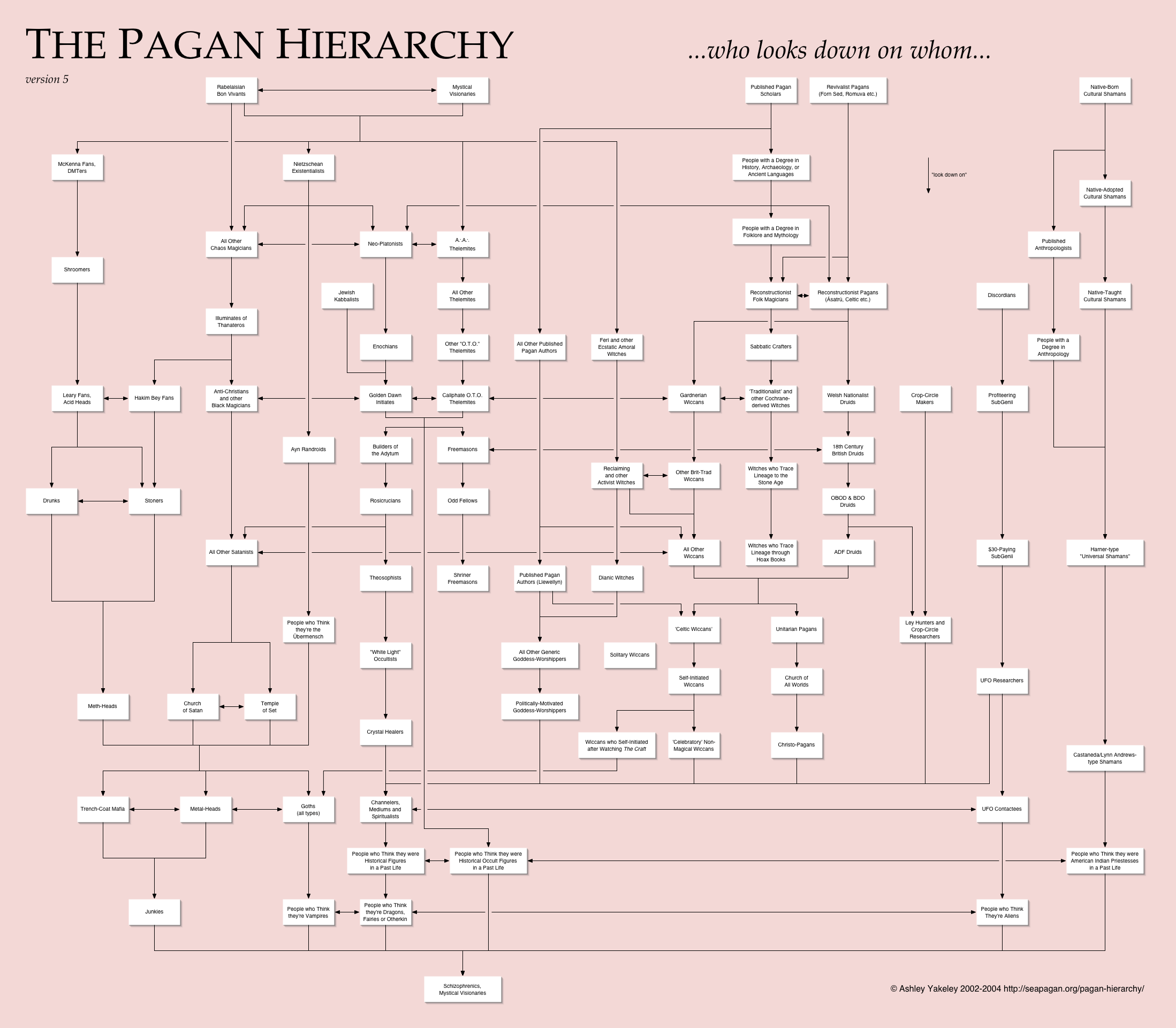
Unfortunately, I’ve seen the exact same problem come up in pagan circles. Just to name some examples, there are some Asatrúar looking down on Wiccans who work with the Northern gods in their paradigm, or there are Celtic Recons essentially making fun of new adherents who are attracted to an idea of Celtic spirituality that they do not share or think correct. Some groups seem to forget that everybody started off as a newbie – even the famous Elder Recon, who now looks down on the newbies’ lack of knowledge – and/or fail to see that reading libraries full of archaeological texts before engaging in worship isn’t the right path for everyone. A – more or less – funny summary of “who looks down on whom” can be seen here:

Obviously you’re allowed your own opinion – I, for once, don’t engage in eclectic witchcraft, but I can understand why this would be the right path for others. Especially in a minority faith like ours, we should be more accepting towards other branches so we can make a stronger impact on the public – not to proselytise, but to make our religious demands known (e.g. concerning our sabbats being recognized as holidays).

In the end, I believe that there is more than one way to find the Gods, and within this way there are multiple smaller paths that one can choose to walk on; and all these different paths are valid for the people walking them. I’m just terribly annoyed by people of any faith claiming that other paths (or for atheists, that all paths) do not actually exist or that theirs is the best one. So I’m hoping for more understanding and getting to know each-other in interfaith dialogue so we can all let each other live our respective (non-)religious lives.

Blessed be,
Harzgeist

Sources 
cartoon: http://www.chick.com/reading/tracts/0046/0046_01.ASP
bus ad: http://a4.sphotos.ak.fbcdn.net/hphotos-ak-ash4/419906_362799317082861_205344452828349_1351162_1223978752_n.jpg
pagan hierarchy: http://seapagan.org/pagan-hierarchy/pagan-hierarchy.png  

Donnerstag, 22. März 2012

Spring Equinox 2012


What is happening in Nature?

On or around the 20th of March, depending on our preferences and schedules, we as pagans celebrate the spring equinox. Day and night are of the same length, and after today, the days will get longer and warmer – winter has finally ended! So the equinox is a time to celebrate: new growth is visible in nature as new flowers rear their tender heads to the sun, and we too shed our thick winter clothing and start walking barefoot to feel the new grass underneath our feet.
On this day, I honour Anann, my matron, in Her aspect as earth goddess, as She is the land, the green country that starts to blossom now.

Themes of the sabbat

For this sabbat, we concentrate on balance. As much as day and night are balanced, we too need to look for balance in our daily lives – balance of work and pastimes, balance of mundane and spiritual activities, balance of time spent alone or with loved ones. The equinox, with the return of the sun after a period of darkness, is also a time of rebirth and new beginnings (Blake 2009: 125). So in a ritual we can ask ourselves which groundwork we need to do before we can express our souls and deepest desires. How indeed can we find space and time for cultivating the soul (Freeman 2001: 72)?

How can we celebrate it?

With kids around, we can make the celebrations of the equinox a very lively, joyful one – for example, we can colour eggs together with them, or play football games or tug-of-war to symbolize the war between darkness and light that on this day comes to a standstill (Kondratiev 2003: 164; 168).
When working alone or with a group of adults, a meditation on the sleeping Oak King can be appropriate; we will visit him in his winter resting place and wake him up to journey with him and behold his rise to full power on Bealtain when he marries the Flower Maiden (Kondratiev 2003: 166ff.).

My celebrations

For my solitary celebration, I start with setting the altar with candles in spring colours (pastels, greens) and daffodils. My husband and I have pancakes for lunch as a symbol of the sun.
After a ritual shower which I use to attune with Manannán, whose element is water, I go to circle in the early afternoon (usually I hold ritual at night or at dusk, but for a spring celebration feeling the sun on my skin seems more appropriate). Usually I’d use 9 candles to mark the circle, but today I’m going for petals.
After calling the quarters with meditations found in Kondratiev’s book, I invite my Gods and Goddesses, as well as my ancestors* and the landvaettir.
I then meditate on the new season and find one (or mostly two) areas where I find I need balance in the months to come.
I end my ritual with feasting on coloured eggs. This year, I use store-bought ones; I’ll colour eggs myself together with my little brother at the family Easter celebrations (watch out for my “H” post on holidays with the family where I’ll delve further into this topic). 

 my altar for the spring equinox

Symbols

An obvious symbol to choose for altar decorations today is the egg that brings to mind the Cosmic Egg of the Druids that hatched the world. Kondratiev (2003: 164) also suggests red eggs, as red is the colour of blood and hence fertility.
Other choices could be the hare – or Eostre bunny if you’ve got kids -, chickens or birds like little geese that fly freely in the warm spring air; basically anything that is afoot now in your area seems a good decoration.
Fresh flowers to me are also a must; I usually go for daffodils, but any flower that is in bloom now or that has a bright sun colour is appropriate. Any further decorations, like candles or the altar cloth if your tradition uses one, can be done in pastels – any nice, warm colour that you associate with springtime is great.
If you choose to do a meditation on where you’ll need balance you might also want to have or create a symbol of whatever you want to implement in the coming months. So you have a visual reminder of which work needs to be done.

What can we take with us after the celebration is over?

For me, the spring equinox celebration isn’t over once I end my ritual. The plans we made at Imbolc still have to be implemented and put to action (Blake 2009: 126); for me this would be getting back to the novel and plot.
Also, I’ll do a spiritual spring cleaning (Blake 2009: 128ff.) once the weekend approaches and I’ll have more spare time on my hands; this will include: 
-   cleaning the house – swiping the floors, de-cluttering cupboards and wardrobes, cleaning the windows, the whole nine yards
-  clearing away negative energies – after cleaning, I will use incense to rid my flat of any residual negative energies
-   cleansing my body – by meditations and affirmations said each night before bed
I don’t know if I’ll get round to it in the end, since I have a presentation and oral exam coming up, but I’d like to try and follow up on my spring equinox meditation. So either each day, or at least once a week, I’d like to revisit my goals so I can grow and sit back on the autumn equinox and reap the seeds I’ve sown now.

* a note on my ancestors: thanks to a hint I picked up somewhere in the PBP, I now see my ancestors not only as my family members who’ve passed. I also call upon those ancestors who have worked in the same craft as I do, e.g. writing, so I’ll ask my favourite German poet to be present, too.


Sources:
Blake, Deborah. 2009. “Speing Equinox.” In: Llewellyn’s Sabbats Almanac Samhain 2009 to
Mabon 2010. Ed. by Ed Day. Woodbury, MN: Llewellyn Worldwide.
Freeman, Mara. 2001. Kindling the Celtic Spirit. New York: HarperCollins.
Kondratiev, Alexei. 2003. The Apple Branch. A Path to Celtic Ritual. New York: Kensington.