When I was staying at my family’s for the Easter holidays, I realized two things – one I talked about in my last post on gospel songs and paganism. The other is that we can learn a lot about each other by attending spiritual services of other faiths, and also enrich our own pagan practice.
My family has always been Christian, although not overtly so – my great-grandma would pray the rosary every week, but privately, and my gran also prays by herself each night. Since my dad passed on three years ago, however, my mum quite often attends services with my little brother (8) and me. As I don’t live at home anymore this usually this happens three to four times a year around the holidays, i.e. Christmas, Easter, Thanksgiving and potentially the service held in summer at a local site in the mountains.
So today I’d like to talk about the last Easter service I went to and what I learned from it.
First of all, I find that attending a Christian mass once every so often is a good and easy way to remind me of the core tenets of Christianity. Not that I’d forget that Easter commemorates the occasion of Jesus rising from the dead, obviously. Instead, the sermon reminds me not only of what is celebrated, but also of what it means for believing Christians. For Easter, this would be a sense of hope pervading all aspects of their life, and a belief that they, too, will rise one day to be with their God. Hearing sermons like these and understanding what it is that Easter means for Christians helps me to see parallels to my own pagan faith.

the altar of the church my mum attends
This brings me to my second point, i.e. that once I see that the sense of hope Christians feel at Easter is similar to the hope and joy I experience during the spring equinox ritual, I might be able to better explain to friends and relatives what it is that I celebrate and believe in. So when I can show that while I do not believe in Jesus, I do focus on hope and the good things in life (that is, not on courting the devil and eating little children), we might have some common ground – and if we cannot agree, maybe we can at least peacefully co-exist, knowing that the other’s beliefs are not too far from one’s own in a sense.
The third and main aspect that really struck me during this year’s Easter service is that in my own pagan practice, I really do miss the sense of community. On the one hand I’m quite happy to be a solitary practitioner, since my schedule is quite messy at the moment and I don’t think I could find time for a regular meet-up; and I also want to explore more of paganism in general before settling for a certain group’s way of doing things.
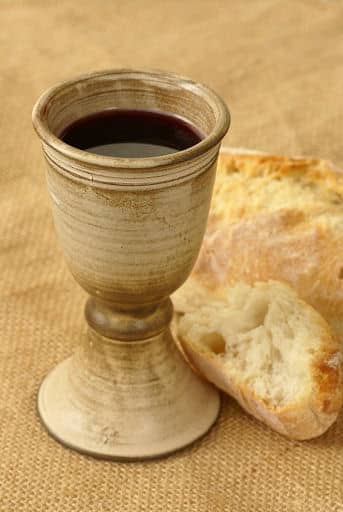
But on the other hand, I really do miss feeling a community spirit. In my mum’s church, the congregation gathers in a circle in front of the altar for the holy communion, and you can partake of both the wine and bread (my dad’s Catholic church, where I used to go to when I was young, only had the priest consume the wine, so this is a really interesting experience for me). After everyone has partaken of the bread and wine, you take your neighbour by the hand and the circle is blessed by the priest or priestess. This sharing of bread and wine, to me, is closer to Jesus’ original idea than the Catholic practice that I grew up with, and it also reminds me of the fact that you’re not alone, but celebrating your faith together with others.
Also, I simply love singing with others to praise God. While I’m quite happy with my own singing voice, it just doesn’t compare to a whole church packed with people singing well-known gospels.
And finally, I miss having a proper ritual structure. I do like to experiment with how I do ritual. However, I find that once you have a set structure you can concentrate better on what the words and gestures mean to you personally instead of fretting about getting the next ritual step right. Also, a fixed structure gives me a sort of comfort, because no matter where you enter a church of a certain denomination, the structure will be the same (or very similar, at least) and you can feel instantly at home.
So how can I adapt the things I miss into my practice?
I talked about the gospel songs last week, so I’m not going to go into detail here. As to the community aspect, I’m planning on asking a Wiccan friend of mine if we could celebrate some of the sabbats together. While I’m not Wiccan myself, I guess our core beliefs are close enough for us to get a meaningful ritual structure that we could work with. Another friend has asked me whether I’d do a little pagan ceremony on our annual Walpurgisnacht trip up the local hill (Walpurgisnacht is the night between April 30th and May 1st, i.e. the German version of Bealtaine), so if all present are fine with it, I might share some bread and mead with the group.
And as to the ritual structure, I don’t have a perfect solution just yet, but since the structure I used for my spring equinox ritual worked really well, I might use it again for the next sabbats and see if I want to stick to it.
As a conclusion, joining my Christian relatives in church is a good way for me to see what they believe in and celebrate on their holy days, and it also gets me to reflect about the current state of my own faith and how I can make my celebrations be even more to my liking.
Do you have other thoughts about attending mass (or the services of other faiths, depending on what faith your relatives adhere to) together with your family? Do you do it at all, and if not, why?
Blessed be,
Harzgeist