Welcome to a more or less Celtic Reconstructionist blog, where love of the Old Gods is still strong

Sonntag, 4. November 2012

Scientific Sunday – Rituals Vol.1: Arnold van Gennep’s Les rites de passage


Dear readers, 
after this blog has been dormant for a while now due to a lot of work on my PhD, as well as some seriously needed holidays of hiking in the Alps and in the woods around my hometown, today I’d like to introduce you to a new weekly feature: the Scientific Sunday!
Each Sunday, there will be a post based on the reading I’m doing for a university seminar on rituals – we’ll be looking at rituals from an anthropologic, a Christian and other perspectives. In my posts, I’ll summarize the most interesting facts and try to relate them to pagan religious practices. Thus, I see my posts as a way of understanding what we as pagams are doing and, hopefully, why we’re doing it, so we can be more mindful of our practices, or include new (daily) practices into our lives to attune more with our spirituality and/or the divine.

Today’s first installment of Scientific Sunday is concerned with the work of Arnold van Gennep (1873—1957), a French ethnographer and folklorist, whose research interests include the theory of folk tales as well as rituals. This post will focus on the first two chapters of van Gennep’s highly influential text Les rites de passage (The rites of passage), in which  he seeks to establish a classification of ceremonial sequences of rituals designating the transition from one state into another (= rites de passage).

Classification of Rites

Van Gennep works from the assumption that there are both profane and sacred groups in each society. Examples of the former include e.g. the nobility, or the working classes, with subgroups such as the different manual professions. Changing from one group to another requires the person to have or to acquire certain economical or intellectual prerequisites, such as advanced training in hir field. On the contrary, when changing from one state to another in the sacred realm, e.g. from a layperson to a priest, specific ceremonies are required.
Apart from priesthood, there are other ceremonies used to signify entering another state, which are termed rites of passage. These rites of passage include, but are not limited to, ceremonies of birth, puberty, parenthood, entering a higher social class or a special profession. Van Gennep concludes that underlying all these different rites is a similar structure:  


The first part of rites of passage is a rite of separation, in which the practitioner is separated from hir old state in society. Then, a rite of transition follows; this becomes clear in initiations, where an applicant is transformed into a member of a society or group. Finally, there is a rite of integration, which firmly includes the new member into hir chosen group.
It is obvious that some rites can emphasize one aspect while backgrounding others. Funerals, for instance, stress the parting of the community with the dead, while weddings highlight the integration of the new bride or groom into the spouse’s family.  
We further have to note that all rites have specific other aims apart from facilitating a passage, e.g. weddings include fertility rites such as the Heathen concept of blessing the bride with Thor’s hammer, or ordination, which includes binding oneself to one’s God/dess.

Van Gennep further stresses the importance of these rites of passage. On his view, the sacred is ambivalent and relative. Thus, a man living at home is situated in the profane world, but on becoming a traveller he enters the realm of the sacred: he becomes sacred to other communities. Hence, what is sacred depends on one’s current state in society. On changing one’s status, something profane can become sacred, and it is the rites of passage which work to weaken any negative effects these changes might have on the practitioner.

In his theory, van Gennep classifies rites in two aspects: theory and magic. The term theory comprises the ideology or kind of religion in question, while magic is used to designate the methods, that is the ceremonies, rites and cults underlying or actualising the theory.
Looking first at theory, we see that there are two kinds of theories or kinds of religions:

Dynamism, in van Gennep’s terms, is seen as the belief in an impersonal power source such as mana. It is monistic in the sense that on this view, all things are reducible to one source, that is, there is unity.
Animism, on the other hand, assumes a personified power, be it a single being or a collective, an animal or plant (totem), anthropomorphic or amorph (god). This view is dualistic as it assumes the existence of both a material world and a spiritual world (body and soul). As this is a view that I subscribe to, but that is heavily contested by atheists such as Daniel Dennett, I shall come back to it in further posts.
Animism, then, can be subdivided further to include the following religious beliefs:
In totemism, practitioners are said to have a connection or a kinship with a spirit-being, such as an animal or a plant. Spiritism can be defined as a belief in the survival of a spirit after death, as well as teachings derived from contact with said spirit. The term polydemonism describes a belief that all phenomena of nature are controlled by independent, more or less anthropomorphic supernatural powers. And finally, theism is the belief that at least one deity exists; in its specific sense theism conceives of God as personal, present and active in the organization of the world and the universe. This is essentially the conception of God in Christianity, Judaism, Islam as well as in some forms of Hinduism.

Coming now to magic, van Gennep notes six kinds of rites, which come in dyads: 
 
Sympathetic rites work from the view that like attracts like, e.g. making a clay model of an animal and killing the model will ensure a lucky outcome of the hunt.
In its counterpart, contagious rites, natural or acquired qualities and properties of objects can be transferred to humans, either by direct contact or over a distance.
The next dyad comprises direct and indirect rites, with direct rites designating an effect immediately created by the practitioner, e.g. when cursing someone or when using a spell. In indirect rites, however, the effect is created mediately by a higher power, e.g. through prayer, vows, cultic actions. The rite is thus performed to initiate an action by a higher power on behalf of the practitioner.
In the final dyad, positive rites are defined as the practitioner’s wants (volonté), while
negative rites comprise taboos (not-wanting; nolonté); these can be understood only in relation to positive rites.
To give a more elaborate example: a pregnant woman refuses to eat blackberries for fear that her unborn child will be disfigured. This rite is dynamistic (since forces in the blackberries cause disfigurement), contagious (as there is a direct transferral of the berries’ properties to the child), direct (as the effect occurs immediately upon eating)  and negative (as the woman refrains from eating).
In another example, a sailor vowed to offer Mary, mother of Jesus, an effigy of a boat if She saved him from drowning. This ritualistic offering is animistic (as Mary is the agent who causes salvation), sympathetic (as the boat effigy is a symbol of the actual boat), indirect (as Mary is acting on the sailor’s behalf) and positive (as the ritual expresses the sailor’s wants, i.e. being saved).
However, we have to note that a rite can be classified in more than one way; and very different rites can belong to the same categories. The classification system is further complicated by the fact that it is especially difficult to decide whether a given rite is animistic or dynamistic, that is, for example, whether a ceremony to cure an illness aims at banishing the illness as such (dynamistic) or a demon personifying the illness in the patient’s body (animistic).

Spatial Passage

At least in Europe, a passport is not required anymore when one wishes to cross from one country to another. While we do see signs of crossing over into another country, such as customs declarations, the actual border of the countries in question can only be seen on maps.
In reality, borders are usually marked in specific locations (e.g. paths, crossroads), either by natural demarcations (woods, stones, rivers, lakes) or by other objects (e.g. standing stones – or the customs booth mentioned above). These markers mark the territory as belonging to a specific group and thereby as being holy.
In magic practices, drawing a circle around the practitioner(s) serves the same function: to set the area apart as belonging to a specific group and activity, and to set it apart as being outside of the mundane.
With the inclusion of gatekeeper gods such as the Celtic Manannán, the Northern Heimdallr, or the Greek Hermes, the physical act of crossing over is transformed into spiritual act as a  personified power ensures a safe crossing. This is acknowledged, for example, in the ADF rites, which include calling on the culture’s gatekeeper.
We have to note, however, that physical and spiritual crossings are not necessarily separate, but usually combined acts.
Coming back to borders, in the Middle Ages and later, there used to be a neutral border between countries or community lands. This strip of land was sacred for the community members, but on standing in neutral zone, the surrounding countries became sacred. Thus on entering the neutral zone, one entered a so-called treshold phase, i.e. one was crossing over from one realm into another. This can be seen e.g. in cutting the circle so that other practitioners can enter.
On a smaller scale, the treshold of a house or home fulfils a similar function and is still of importance in today’s rituals, e.g. in a  ride being carried over treshold at wedding ceremonies.

These treshold rituals all have an underlying schema:

 They usually begin by a rite of separation, which serves to separate the practitioner from the mundane world and to facilitate entering a ritual mindset, e.g. by ritual baths, cleansing, or by putting on ritual garments.
After the rite of transition itself (unfortunately, van Gennep fails to list specific examples), treshold rites conclude by a rite of integration, that is by welcoming the newcomer into the community/the home, e.g. by eating together. In a spiritual rite, this could be the sharing of offerings with the deity one has invited to the ritual.
Interestingly, rites of separation and integration can be similar, as can be seen by Catholics anointing themselves with holy water on entering and leaving the church.

Montag, 9. Juli 2012

Manannán Mac Lír – Son of the Sea


After a longer, work-related hiatus, Mists of Manannán is now back and running! With today's post, I'm catching up with Rowan Pendragon's wonderful Pagan Blog Project (the other letters I've missed will follow in the next couple days, hopefully).

Today, I'd like to introduce you to my patron deity after whom my blog is named – Manannán Mac Lír, Son of the Sea.
As a sea deity, He rules the Celtic Land Under Wave and is especially associated with Mona, the Arran Isles and the Isle of Man. Mara Freeman (2001: 213) lists a prayer spoken to Him by fisherman during Midsummer celebrations on the latter isle:

Manannan Beg Max y Leirr –
Little Manannán Son of the Sea,
Who blessed our Island,
Bless us and our boat, going out well.
Coming in better, with living and dead in our boat.

The prayer thus shows us that He is not solely a sea deity, but also associated with the struggle between life and death. It is in this function that the ADF solidary Celtic ritual format calls Him as a Gatekeeper (since the Norse template calls Heimdallr in the same function, it would be interesting to explore Their potential similarities as Gatekeepers; hopefully I shall come back to this question in another post). I shall quote the ADF invocation in full, since it lists most of Manannán's well-known attributes and possessions:

Oh Manannan, powerful son of the sea, holder of the magics of the crane bag, I ask that you hear my call. Oh Lord of the Otherworld, bearer of the silvered apple branch, join with me this day, so that you may guide me in my workings. Mist-shrouded rider of the maned waves, accept my offering and open the gates between my realm and yours.“

So we find in this invocation reference to Manannán riding His chariot Ocean Sweeper and His horses, the waves, of which Enbarr (Waterfoam) is His favourite. Manannán also owns a silver apple branch, a tale of which can be found retold in Freeman (2001: 90-96), and a crane bag. He also possesses a great shining cloak that changes colour like the sea itself.
When the Tuatha Dé Danann were driven underground by the Milesians, Manannán took the function of the gods’s advisor and appointed each one a sidhe mound. He also gave three gifts: the féth fiada, which is a cloak of invisibility, the Feast of Goibniu, which lets you stay young eternally, as well as magical pigs which come alive again after having been eaten (Freeman 2001: 213). It might be in this context of the sidhe mounds that the Faerie queen Aíne is said to be Manannán's daughter (Rakine/D’Este 2005: 136).


There are many more legends and facts that one could cite about Manannán; if you're interested to learn more about His history, you will find a wealth of information here.
So instead of retelling His myths, I shall conclude my post with personal experiences of Him.
To quote the introductory page of http://www.manannan.net/, He is “the God of Oceans, lord of storms and weather, master of magical arts, and a friend to all dreamers,” who has “a personality full of mirth and humor, as well as wisdom.” This coincides with my own experience of Him – He is a very approachable deity, who has a great sense of humour. Be sure not to petition him not to let it rain now – you can be sure that it will most certainly rain the next time you leave the house... To me, Manannán is a fatherly figure who is always there to listen to my troubles and who is willing to keep me safe.

Two songs by the wonderful artist Vienna Teng quite nicely express the mood of Manannán: her “Lullaby for a Stormy Night,” whose lyrics reference a scared little child who is comforted by a “gentle someone” - this is my impression of what defines Manannán as my patron deity. Her second song, “Harbor,” with its connection to water also strongly reminds me of Manannán.

Another wonderful song by Ken Therion, called “Son of the Sea,” recounts a lot of His legends and symbolisms from Manannán's perspective and is thus a great source of information when you want to connect to Him.

And finally, Skeeal's “Manannán,” sung in Manx, is a beautiful song about Him and His connection to Manx fishermen (you can find the lyrics and a rough translation of it here).


Finally, if you are intrigued to get to know Manannán, I find that the Ritual of the Mists found here is a very nice ritual when you work as a solitary and want to connect with Him further; best done at the waterfront. I find that offerings of apples are generally very well accepted.

If you already know Manannán, what are your experiences with Him?

Blessed be,
Harzgeist

Sources:
books:
Freeman, Mara. 2001. Kindling the Celtic Spirit. New York: HarperCollins.
Rankine, David and Sorita D’Este. 2005. The Guises of the Morrighan. Irish Goddess of Sex and Battle: Her Myths, Powers & Mysteries. London: Avalonia.

online sources:
http://www.manannan.net/images/manannan/splendidmane.jpg

songs:

http://www.youtube.com/watch?v=bZd2kgLZtfA Vienna Teng - Lullaby For A Stormy Night

http://www.youtube.com/watch?v=tKDXe0FP2wc Vienna Teng - Harbor

http://www.youtube.com/watch?v=NrTXYsaVd9I Ken Theriot – Son of the Sea

Samstag, 2. Juni 2012

KISS Mythology – A Very Eclectic Way of Calling the Quarters

Better late than never... I’ve been meaning to post for some time now, but life kept getting in the way in the form of work, a concert of the fabulous Bruce Springsteen which I’d been waiting to see for more than 10 years now, theatre planning sessions (we’re performing As You Like It) and other stuff.
So, finally, for my first K post in the wonderful Pagan Blog Project challenge, I’d like to leave my usual route of discussing Celtic or Northern gods and mythology and delve into something far more eclectic: KISS mythology.

Yes, you guessed correctly: by KISS I mean the 80s hard rock band. My dad was a big fan of their songs, and when I was 10, he introduced me to their music. I still remember the Saturday afternoon when we sat in my great-grandma’s room, listening to KISS’ Dynasty record. So in the sense that KISS will always be connected with this moment and the memory of my dad, they are a very important, almost magical band to me. 
 The original band members: 
Gene Simmons as Demon, Paul Stanley as Starchild, Ace Frehley as Space Ace and Peter Criss as Catman

In the late 1990s, when out shopping for magazines, I found the first Psycho Circus comic by KISS in our local railway station shop. Naturally, I had to buy it although it was fairly expensive at the time. I read it right when I came home, and I was mesmerized. The Psycho Circus series describes the life of circus artists, who are inseparably linked to the Four-Who-Are-One, i.e. the mythologized versions of the KISS stage personas.
The second instalment of the series described these characters as follows:

The Demon - Lord of the Wasteland - Creature of fire and shadow, blood and thunder. He embodies vengeance and terror, the darkest impulses of mortal souls, but also the purgative flames of rebirth, destruction that proceeds creation. His is the element of fire.

The Starbearer - Prince of Hearts - He who draws from the deep wells of the soul and emotion, bringer of passion and pain. He can move a heart to tender love or murderous rage. His is the element of water.

King of Beasts - Lord of the Hunt - Personifies the primal animal instinct, the rough beast that stirs in each of us. Embracing instinct rather than intellect, he knows neither cruelty nor mercy. His is the element of earth.

The Celestial - Scion of the Cosmos - Represents the principles of universal balance, the ultimate harmony of the cosmos. Observes situations dispassionately and sees all sides of a dilemma. His is the element of air.

At about the time I read these comics, I started with my first tentative steps on the road to paganism. Unfortunately, all that was available in my small town’s library were not-so-well-written books on ghosts, spirits, DIY books on white magic etc., none of them by well-known authors. So what my best friend at the time and me did was more or less develop our own, very much eclectic ideas of what witchcraft was and how we could work with it.
Quite a lot of the books I read talked about calling the corners or elements, but none gave an appropriate description of how to do it that appealed to me. For me, these elements were too abstract to do anything with them, much less call on them and interact with them. But then I realized that in the KISS comics, the Four-Who-Are-One each represent one element. Hence, I devised my very eclectic version of calling the quarters that I still use today when working magic.

My plan, which I still have to follow up on once I’ll have a bigger flat and a room devoted to my craft, is to decorate each room’s corner with symbols and items that I associate with the elements as described in the Psycho Circus comics. I also have certain smells and natural phenomena that I associate with them.

Here are my associations, in no particular order:

Fire: red, the midday sun, the desert, burnt smells, death, danger, rebirth, fights

Water: deep red or violet roses, purple, deep ponds, the sea, rose gardens, romance, heavy rose smells, emotions, the sunset, the pains of love

Earth: green, lush green flowers, the smell of the earth after the rain, the woods, animals, stones, sticks, natural materials, earthy green or brown smells, night, wilderness

Air: white and black feathers, blue, planets, coldness, the wind, wind chimes, clear high notes, clean smells (such as Davidoff’s Cool Water perfume), fresh blue smells, the void

This is also my main reason why I see Water as purple and Air not as yellow, as in many traditions, but as blue.

I use these correspondences for various reasons. First, I use them to call the quarters when I’m working magic. Since I’m so familiar with both the comics and the band, I have an instant, very personal image for each element when I call upon it; this seems to work better for me than to use somebody else’s version of the elements.
Second, I use the colour correspondences and/or smells to invite a certain mood or emotion into my day. For example, if I think that I’ll need to be very susceptible for emotions, e.g. when speaking to a friend who’s lovesick, I’ll wear something purple or use my rose perfume. On the other hand, when I know I’ll be in a situation where arguments will likely arise, I’ll rely on a red pendant and focus on the Demon aspect, i.e. that from each conflict and each death, something new will arise. And finally, I also use them as focalizers, so to speak, for visualizing which abilities I’d like to invite into my life. 
 Madame Raven using her tarot cards and calling upon the Four-Who-Are-One*

While this is indeed a very eclectic system that isn’t even based in a ‘proper’ mythology, it has been proven to work time and again for me. I’ve also written a story based on Madame Raven, a member of the circus, and her ability to call on the Four-Who-Are-One using her tarot cards (you can order the book that includes my story here).

So how do you call upon the elements? Which are very eclectic practices of yours, and what are they based on?

Blessed be,
Harzgeist

Sources:
KISS Psycho Circus volumes 2, 6, 10
KISS band image: http://www.nolifetilmetal.com/images/kiss_circuspic.jpg

* a translation of the German reads: 
I call out to the North in the name of Starbearer, prince of hearts, who draws from the springs of soul and emotion. 
I call out to the West in the name of Beast King, master of the hunt, protector of nature. 
I call out to the East in the name of Celestial, spawn of the cosmos, wo represents universal balance. 
I call out to the South in the name of Demon, lord of the wasteland, sinister executor of vengeance and terror.
I hear Madame Raven calling upon the four directions. Her voice is so soft... I am very close to her, but far away...

Freitag, 18. Mai 2012

Jewellery - Pros and Cons of Wearing Religious Symbols


Quite a lot of religious people of any denomination choose to wear symbols of your faith, either permanently or for special occasions – e.g. a hammer when you’re a Heathen, a cross when you’re a Christian, etc. 
 For today’s post, I’d like to delve a bit deeper into the reason of why people decide to wear such jewellery. There’s also an interesting aspect of why people choose to have their faith’s symbols tattooed onto their skin, but we’ll get there in my “T” post.

One of the reasons why I think wearing religious jewellery is a nice idea is that it helps others of the same faith to identify each-other – we see somebody also wearing a hammer and we might have been lucky to meet another heathen (however, s/he could just be into metal, but I’ll get there later).

Secondly, and this is quite an ambivalent point, wearing these symbols gives away important information about you. Just like with the way you dress, or you wear your hair, by wearing religious jewellery you inform your surroundings about where you’d like to be placed, i.e. in which box they should put you. Generally, people love categorizing things and people in boxes, since it helps them to make sense of the world around them (Pendry 2007: 114). For example, if you’re starting work in a lawyer’s office today, you might infer that the nice, well-groomed lady in a suit is a potential colleague, and that the lady in a normal dress who’s kneading her tissue in her hand is a potential client. Thus, forming categories of the world helps us to understand it and to react to other people. And if I can influence this process for others to understand me better and to get a more accurate picture of myself, so be it. Hence, I wear a hammer every so often, and I dress mostly in black, jeans, leather and biker boots, cause I’d rather be seen as a Helena Bonham Carter-esque rebel than as somebody who conforms to all of society’s rules.
 Helena Bonham Carter - this is the box I'd happily be put into
However – and I feel this is an issue needing to be stressed – wearing religious symbols can backfire terribly. Coming back to the situation when you meet this nice heathen fellow, you might be disappointed to realize the only thing they know about Odin is what was in that song by Manowar, and that they just donned the necklace because they found it was cool or because it was pictured on an album cover they liked. The same happens – and I believe far more often – with Celtic symbols. But then again, usually you don’t go up to random people in the street and start talking about the Goddess just because they are wearing a Celtic pendant. A more problematic issue is when people see the symbol you’re wearing and automatically class you as “evil,” “bad” or what-have-you and don’t bother to get to know you personally. This is sad, but that wouldn’t stop me from wearing a hammer – people like this would quite as easily find another reason why I don’t confirm to their standards, and I have no intention of changing myself to confirm to somebody else’s ideal of a human being.

On the other hand, wearing religious jewellery can help educate people about our faith. Around the time the first Thor movie was out, I went to a friend’s birthday party. Somebody saw my necklace, inquired about it, and suddenly we had a very nice, very enlightening discussion about paganism and what it means to the individual. I think that explaining to this one man what paganism was doesn’t change the world, but at least there will be one more individual who knows about us and that we don’t eat little children. So if all of this can be achieved simply by wearing a necklace, I’m all for it.
Can wearing a hammer pendant help people understand that Thor isn't like in the movies?

 However, I feel there are places where religion doesn’t really belong. In your free time, you can wear whatever you like, but just as there are dress codes for some jobs (think of them whatever you will; I don’t think most of them are necessary, apart from when the health of patients is concerned) I think there are situations where religion doesn’t have to play a role. In my workplace, for instance, we’re all about football, but I wouldn’t expect anyone to turn up in the morning wearing their team’s jersey, because ultimately, you come to the workplace to work, do your job well, and not to proselytize.
I’m by no means suggesting that religious discussions should be kept from the workplace – it’s only I feel that, especially when you’re new in your position like myself at the moment – non-committal subjects like football are safer and easier to talk about (you may strongly identify with your team, but religion usually goes much deeper than that). Thus, I’d suggest wearing smaller, less obtrusive versions of your chosen symbols. For example, I have this huge bronze hammer pendant, which is really very obviously pagan from a mile away; since I feel this is a bit much for work, I’m looking for a smaller, silver version at the moment.

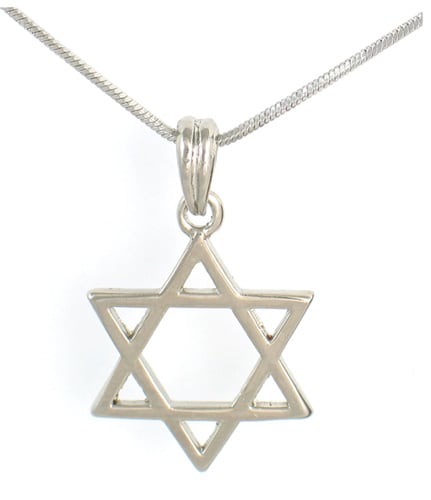
Another thing that crossed my mind is that sometimes, your symbol of choice can be quite easily mistaken for something else. This happens quite often with pentacles, so be prepared that people might think you’re either Jewish or a Satanist, and be prepared to give a short, easy explanation why you’re neither and what your faith means for you.
 people sometimes do mistake this Star of David for a pentacle, so be prepared to explain what your faith means
 
Finally, if you’re unsure about whether your friends, relatives or colleagues would approve of you wearing a religious symbol, you might also want to consider wearing jewellery that is meaningful to you and your faith without openly stating it, so to speak (this might especially be important for teens living with a family of another faith). For instance, I’m wearing a braided leather bracelet that connects me to Odin – it doesn’t say “Heathen” straight away, and I can wear it to work without people commenting on my faith when I’m not ready or willing to discuss it (as I said, we’re all about football in the company, so I’d rather spend my break discussing the latest match instead of religion). Others might have a special set of earrings in the colour associated with their deity, or an item they bought while on holiday in their chosen deity’s country. I’ve also heard of objects blessed for specific purposes, let’s say being able to stay calm when dealing with customers, and worn to work. Those don’t have to look magical at all, but knowing they’re there might give you that push to get through the day without shouting at anyone.


So what do you do? Do you wear a symbol of your faith at all? Would others be able to recognize it? I’m assuming that, at least in Germany, if somebody wore a valknut most people would rather think they were supporting the German Football Association than that they are a devotee to Odin.
Or do you think that advertising a minority faith is too risky in your environment? I’m very interested to hear different opinions!
 
 
Blessed be,
Harzgeist

Sources:
Pendry, Louise. 2007. „Soziale Kognition.“ In: Stroebe, W., Hewstone, M., Jonas, K. (Hrgs.): Sozialpsychologie. 5. Aufl. Heidelberg: Springer, 111-145. [German edition]
Manowar - Sons of Odin: http://www.youtube.com/watch?v=a8XIW_jUa-k

Pentacle: http://www.earthly-gems.co.uk/acatalog/pentacle-pendant-26110-1lge.gif
Thor's Hammer: http://www.jelldragon.com/images/sn_thors_hammer_necklace_1.jpg 
Helena Bonham Carter: http://www.freewebs.com/thedemonbarberoffleetstreet/Helena02.jpg
Thor movie: http://vervemedia.org.uk/wp-content/uploads/2011/09/Manchesters-Finest_thor-movie-440x326.jpg
DFB (German Football Association) logo: http://upload.wikimedia.org/wikipedia/de/c/c0/DFB-Logo.svg

Sonntag, 6. Mai 2012

Inspiration and Identity


A lot of Pagans I’ve encountered like to give offerings to our Gods – some offer physical objects, like wine and mead, some offer crafts they’ve created, like altar cloths, and some offer their talent, like singers. Being a writer, I do the latter. 

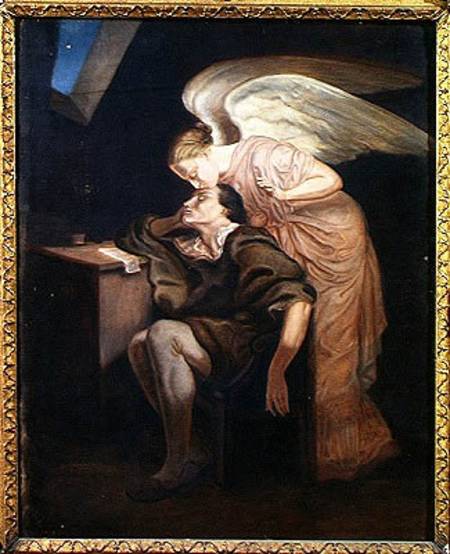
When you’re working in a creative field yourself, maybe you’ve also felt this sudden pull to take that notebook or sketch pad and paint or write down this unexpected new idea. Perhaps you – just like me – have wondered where these ideas, this art of ours comes from. 
Clearly, some of it is inspired by other works of art I encounter. When I was still at school, I read a lot – about one to two novels a week. Today, I don’t have as much free time, but I still try to read as much as I can, at least the new works of my favourite writers. And I attend a Creative Writing course once a week, where I can present my writing, get feedback and also get new ideas. But one question still remains: Where does this divine spark to create something new come from? 

I like to think about this in terms of my muse (cf. King 2000): He lives in an old, run-down changing room in a theatre (don’t ask me why he likes to hang out there; but I’ve never seen him anywhere else). He looks a little like Jim Morrison, with wavy brown curls, and always wears a white v-necked shirt and faded blue jeans. When he helps me out with a story, I pay him in whiskey or similar hard alcohol. But I have to keep up my part of the bargain – when he sends me that inspiration, I have to write it down and acknowledge it, even if it means getting up at 3am and searching for a pen and notebook. 
 You could say that when I’m talking to my muse, what I’m essentially doing is talking to my own subconscious which, for some unfathomable reason, likes to dress up as Jim Morrison’s look-alike. But be that as it may, I wonder how our Gods feature in this process. After all, Odin grants the mead of poetic inspiration; in the Celtic pantheon, Brighid is associated with the “fire in the head” of inspiration (also see my B post on Her). However, when I’m writing I’ve seriously never felt Their presence, even if the work I produce is about Them.
So while I see writing as an integral part of myself (hence the Identity title), I still don’t know what makes me, or rather, what drives me to write. What I know, however,  is how to write and how to be inspired. 

So how can we make inspiration flow (cf. Myers 2008: 477)?
  • First of all, learn as much as you can about your craft – only when you have a good working knowledge of what has been done, of different styles etc. can you combine them in new, interesting ways.
  •  Be risky – sometimes, you have to take a certain risk: you won’t know if combining a horror story and crime elements will work unless you try.
  •  Learn to see things in new, creative ways – e.g. what could you use a brick for? To build houses, sure, but couldn’t you also use it as a paper weight, as a weapon, as a doorstopper, as a device to keep your table from wobbling? It’s these instances that will give you new insights and inspire you to come up with novel stories. 
  •  Look for others who are creative and who will support you – your creativity can thrive best if there are others who are either creative themselves, so you can inspire each other, or when they are accepting of your craft. Imagine writing a story when your SO keeps telling you that it’s a waste of time and/or silly – you’d have to be very dedicated to keep at it! Also, create an “imaginary friend,” your Constant Reader (or Constant Gallery Visitor, or Constant Concertgoer). S/he is your prototypical target audience. So you can ask yourself while working on your creative product: would Constant Reader enjoy this? Does s/he expect something entirely different now and will s/he be disappointed if s/he reads, sees or hears my new take on things? Basically, Constant Reader allows you to keep your intended audience in mind and not to stray too far from your intended path (King 2000).
  • When you’re planning to work creatively, no matter if you’re planning on being a professional artist or if you’re just working for yourself, you have to want to do it, simply because you enjoy the process of doing it. It has been shown that when two groups of people work on a creative project, the ones who are told that their work will be judged are less creative. So just write for the sake of writing, sing because you love it, and you’ll come up with more new, interesting ideas than if you plan to be the new J.K. Rowling, Montserrat Caballé or Dalí.  
  •  And finally, when you do all the things above, you have to practice continuously. Sure, writing only when you feel that divine spark of inspiration will produce some very nice stories or poems. I, for once, see myself as a Romantic poet who can only write when inspired or called to do so. However, you get better with practice, esp. when it comes to writing stories, dialogue that sounds natural, creating suspense and atmosphere – a writer I’ve met suggested to write a few pages each morning and to keep writing even if everything you turn out feels like s**t, cause this will stop your Inner Editor from complaining and making you feel insecure.
To finish off this post, here’s a poem about Odin I wrote recently. It is inspired both by the German Symbolist poet Stefan George (if you can read German, his poem is here) as well as German Expressionist writers, esp. August Stramm

autumn

the trees were shedding
            their golden gowns
when I found you
            amid the cool forest

unannounced I came
but receive me,
my king,
in your court
            in the twilight woodland

others handed you roses -
but my flowers are wild
and free, like the sun
            that is dying

this final blossom
autumn-blue
take, bind it,
            braid it in my hair -
with your nine sacred herbs
a crown
to make my wedding holy

skies darken, blacken in the wind
autumn air dances
in your war-encrusted curls -
please, leof min,
stay with me
for it is towards evening

silently
beneath the dusk I hear
your laugh,
the night,
the cruel blue winter wind -
and the Wild Hunt
is coming

 
Sources:

King, Stephen. 2000. On Writing. A Memoir of the Craft. London: Hodder & Stoughton.

Myers, David G. 2008. Psychologie. Heidelberg: Springer [German edition]. 

http://www.alb-neckar-schwarzwald.de/s_george_poems.html (Stefan George’s “komm in den totgesagten park“ in both German and English translation)

http://www.firstworldwar.com/poetsandprose/stramm.htm (English translations of two of August Stramm’s poems)

images:


http://www.paranormal.de/symbole/germanen/Odin/Odin4.jpg (Odin)